 ultimate-guide
Cross-Border Defense Joint Ventures: Key Risks
Table of Contents
- Geopolitical Risk and Trade Restrictions in Cross-Border Defense Joint Ventures
- Regulatory Compliance and Export Control Vulnerabilities
- Dual-Use Export Control Compliance and Technology Oversight
- Governance Frameworks and Dispute Resolution in Defense Partnerships
- Anti-Bribery Standards in Defense Procurement and Joint Venture Operations
- Defense Commerce Agency Pricing Models and Capital Allocation Strategy
- Due Diligence, Intellectual Property, and Operational Risk Mitigation
- Frequently Asked Questions
Last Updated: October 4, 2026
Geopolitical Risk and Trade Restrictions in Cross-Border Defense Joint Ventures
Geopolitical shifts pose the most immediate threat to cross-border defense joint ventures. A change in administration, regional conflict, or diplomatic dispute can instantly transform a viable partnership into a liability.
Trade restrictions compound this exposure. Geopolitical shifts can trigger sudden sanctions or embargoes that halt supply chains overnight, restricting technology transfer or intellectual property sharing across borders.
Unwinding an operational joint venture takes months or years, equipment relocation, contract renegotiation, personnel reassignment, leaving the venture in regulatory limbo with substantial financial and reputational exposure.
Defense procurement officers must assess geopolitical stability before committing capital, evaluating upcoming elections, regional tensions, NATO alignment, and sanctions history. DIAGRAM8's multi-jurisdictional compliance framework helps institutional partners identify these risks early.
Regulatory Compliance and Export Control Vulnerabilities
Export control frameworks vary significantly across jurisdictions. Each nation maintains its own list of controlled items, restricted destinations, and end-use verification requirements. A component legal to export from one country may be prohibited from another.
In joint ventures, both partners must comply with their own nation's export controls and the other nation's controls. Manufacturing in one country for delivery to a third country may trigger three separate regulatory regimes. Missing a single requirement can trigger criminal penalties, contract termination, and loss of export privileges.
Export compliance is continuous, not a one-time approval. End-user verification, re-export controls, and technical data restrictions apply throughout the product lifecycle and require re-approval if the end-user or product changes.
Defense export rules are updated regularly to reflect new technologies, geopolitical shifts, and treaty obligations. Partners must maintain real-time awareness of regulatory changes and adjust operations accordingly.
Dual-Use Export Control Compliance and Technology Oversight
Dual-use technology presents acute compliance challenges. These items have legitimate commercial applications but can also be used for military purposes and face heightened scrutiny.
The exporter must verify the end-user's identity, intended use, and destination before shipping dual-use goods. If verification fails or reveals red flags, the transaction must be halted.
In joint ventures, responsibility for dual-use compliance often becomes unclear, who conducts end-user verification, maintains documentation, or handles discovered restrictions. These ambiguities create operational friction and legal exposure.
AI and Advanced Manufacturing as Dual-Use Technology
AI and advanced manufacturing technologies add a distinct layer of complexity that most defense partnerships underestimate.
Unlike traditional dual-use items, AI systems are intangible, easily copied, and difficult to monitor after transfer. Once shared, controlling onward transfer or modification is nearly impossible.
Regulatory frameworks remain inconsistent on AI classification. A joint venture involving AI must determine upfront which partner owns the system, who can access it, and what happens if regulatory classifications change.
Example: A joint venture develops an AI system for predictive maintenance, reducing waste by 15%. Six months in, the home nation classifies defense manufacturing AI as controlled items.
Technology Transfer and Compliance Governance
Technology transfer in defense joint ventures must be treated as a compliance event, not a routine operational detail. When one partner transfers AI, software, or advanced manufacturing processes to the other, the agreement should specify:
- Ownership and control: Who owns the intellectual property? Can the receiving partner modify it? Can they license it to third parties?
- Access controls: How is the technology protected from unauthorized access or onward transfer? What security standards apply?
- Regulatory notification: Must the transfer be reported to government authorities? Which nation's authorities must approve it?
- Modification restrictions: If the receiving partner modifies the technology, does it trigger re-export control requirements? Who determines whether a modification requires new regulatory approval?
- Audit rights: Can the originating partner audit the receiving partner's use of the technology to ensure compliance?
Many joint ventures treat technology transfer as a one-time event rather than ongoing compliance. Establish a Technology Transfer Committee to review transfers, assess regulatory implications, and determine required approvals before transfer occurs.
Supply Chain Transparency and Supplier Verification
Dual-use compliance extends to the supply chain. If the venture uses components from sanctioned suppliers or suppliers with unclear end-users, the entire venture faces liability.
Supplier verification for dual-use components requires:
- Supplier screening: Does the supplier have a history of sanctions violations or export control violations? Are they on any government watchlists?
- Product traceability: Can the supplier certify that components were manufactured for the stated end-use and not diverted?
- Audit rights: Can the joint venture audit the supplier's records to verify compliance?
- Contractual indemnification: If the supplier provides false certifications, who bears the liability?
Conduct annual supplier re-certification and spot audits of high-risk suppliers. If a supplier's regulatory status changes, acquisition by a sanctioned company or operations in restricted jurisdictions, reassess continued use.
Emerging Technology Categories and Regulatory Uncertainty
Regulatory frameworks struggle to keep pace with emerging technologies like quantum computing, advanced robotics, and synthetic biology. Joint ventures face the risk that products will be reclassified as controlled mid-project.
Build regulatory uncertainty into the venture's financial model and timeline.
Governance Frameworks and Dispute Resolution in Defense Partnerships
A well-structured governance framework determines how decisions are made, who holds veto power, and how compliance responsibility and liability are allocated, where most partnerships fail.
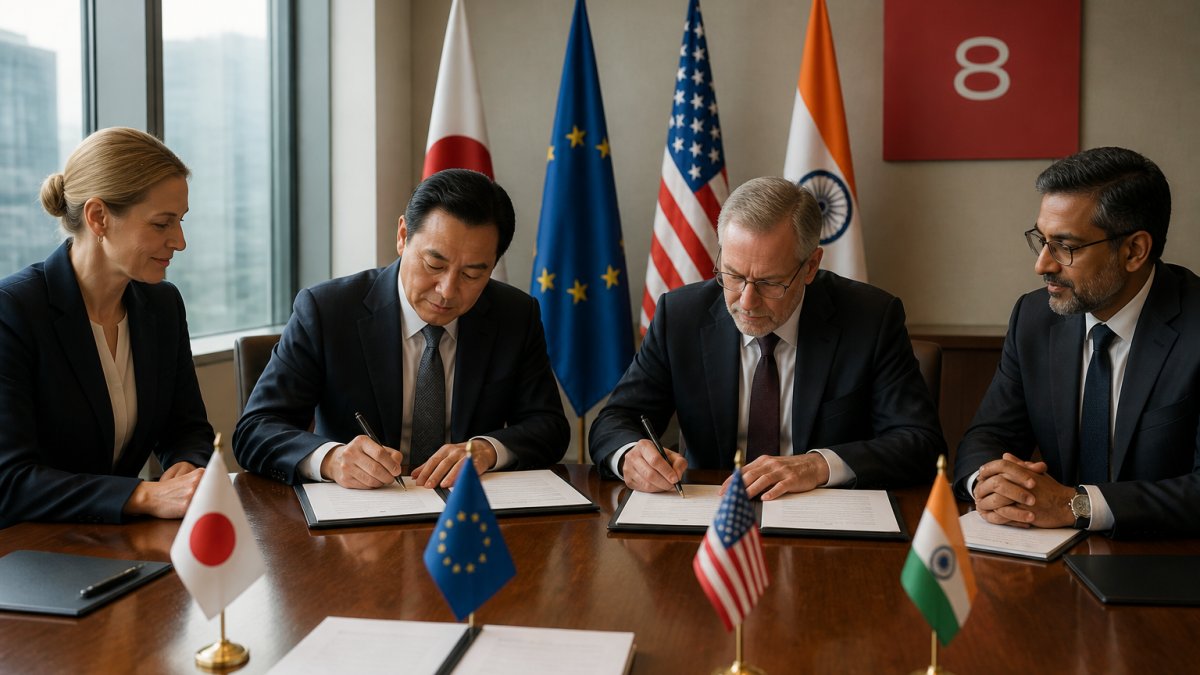
Compliance authority must not be diffused across teams without unilateral decision-making power. When regulatory changes occur, consensus-seeking delays can close the window for voluntary disclosure, forcing mandatory reporting instead.
Separate operational decisions from compliance decisions. A dedicated compliance officer or committee should have unilateral authority to halt operations, freeze shipments, or escalate to regulators, reporting directly to the board. Compliance decisions must be binding and non-negotiable.
Disputes in defense joint ventures are frequently regulatory, not financial. The agreement should specify that regulatory disputes are resolved through expedited expert determination with defense compliance credentials, not standard arbitration.
Specify that each party remains responsible for compliance with their own nation's laws, but contractual disputes are resolved under a neutral framework such as the UNCITRAL Model Law. This acknowledges that regulatory compliance is non-negotiable while allowing fair contract interpretation disputes.
Include indemnification clauses that allocate liability based on which partner's action or negligence triggered the violation. If Partner A fails to conduct end-user verification and violates export controls, Partner A indemnifies Partner B for regulatory penalties and fines.
The agreement must specify which nation's export control regime takes precedence if the two conflict and define what "compliance" means operationally. Require quarterly compliance certifications from each partner, with the right to conduct unannounced audits if red flags emerge.
Include escalation procedures for regulatory uncertainty. When a transaction falls into a gray area, halt it pending regulatory clarification. This prevents proceeding on the assumption that ambiguity equals permission.
Anti-Bribery Standards in Defense Procurement and Joint Venture Operations
Anti-bribery standards in defense procurement are non-negotiable and increasingly stringent. Many nations have adopted anti-bribery legislation modeled on international standards, requiring that defense contractors maintain strong controls against corruption. In a joint venture, both partners must comply with their own nation's anti-bribery laws AND be prepared for the other partner's compliance audits.
The risk is not limited to overt bribes. Indirect payments, consulting fees, or gifts to government officials, even when legal under local law, may violate the home nation's anti-bribery standards. A joint venture that operates in multiple jurisdictions must navigate these conflicting requirements. What is permissible in one market may trigger criminal liability in another.
Defense procurement officers face particular scrutiny. Government agencies expect their defense contractors to maintain anti-bribery certifications and to audit their partners regularly. A joint venture partner with weak anti-bribery controls can expose the entire venture to contract cancellation and regulatory investigation.
DIAGRAM8 operates under ISO 37001 certification, which establishes anti-bribery management systems aligned with international standards. This certification helps institutional partners demonstrate that their joint ventures maintain compliance with anti-bribery requirements across multiple jurisdictions.
Defense Commerce Agency Pricing Models and Capital Allocation Strategy
Capital allocation in cross-border defense joint ventures requires careful planning around regulatory constraints. Some nations restrict the amount of foreign ownership in defense contractors, which limits how much capital a foreign partner can contribute. Others require that certain manufacturing processes remain under domestic control, which constrains where production can occur and how costs are allocated.
Defense commerce pricing models also reflect regulatory realities. If a component is subject to export controls, the pricing must account for the cost of compliance, end-user verification, documentation, potential delays. If intellectual property must be licensed rather than transferred outright, the licensing terms affect the venture's profitability and the partner's return on investment.
Many joint ventures use tiered pricing structures: one price for domestic delivery, a higher price for allied-nation delivery, and restricted availability for non-allied destinations. This structure reflects the regulatory risk associated with each destination. Partners must agree upfront on how these pricing tiers are determined and how they change if geopolitical conditions shift.
Capital allocation also determines who bears the risk if regulatory changes reduce the venture's profitability. If new export restrictions reduce the addressable market, does the foreign partner absorb the loss, or is it shared? These questions must be answered in the venture's financial structure before capital is deployed.
Due Diligence, Intellectual Property, and Operational Risk Mitigation
Due diligence in cross-border defense joint ventures extends far beyond financial analysis. A comprehensive due diligence process must assess the partner's regulatory history, compliance infrastructure, and intellectual property portfolio. Has the partner been sanctioned? Do they have unresolved export control violations? Are their patents defensible across multiple jurisdictions?
Intellectual property rights in a joint venture create specific vulnerabilities. If one partner contributes patented technology, the agreement must specify how that technology can be used, whether it can be licensed to third parties, and what happens if the patent is challenged. In defense sectors, intellectual property is often tied to export controls, a patent on a dual-use technology may require government approval before it can be licensed internationally.
Operational risk mitigation requires clear processes for handling compliance incidents. If a partner discovers a potential export control violation, the agreement should specify how quickly the other partner must be notified and what steps must be taken to remediate. Delayed notification can turn a minor compliance issue into a major regulatory problem.
Due diligence also examines the partner's supply chain. If the venture manufactures products using components from sanctioned suppliers or restricted sources, the entire venture faces liability. A thorough supply chain audit, conducted before the venture launches, can identify and eliminate these risks.
DIAGRAM8 provides institutional partners with audit-grade due diligence support for cross-border defense joint ventures. This includes regulatory history assessment, compliance infrastructure evaluation, and supply chain vulnerability analysis.
Cross-border defense joint ventures offer substantial strategic value, but they demand disciplined governance and comprehensive risk management. The regulatory landscape is complex, geopolitical conditions are volatile, and the consequences of compliance failures are severe. Institutional partners who invest in rigorous due diligence, clear governance structures, and ongoing compliance monitoring can navigate these risks effectively. Request a formal introduction to DIAGRAM8 to discuss how institutional commerce integration and multi-jurisdictional compliance support can strengthen your cross-border defense partnerships.
Frequently Asked Questions
What are the primary regulatory risks in cross-border defense joint ventures?
Primary regulatory risks include export control violations, sanctions compliance failures, and multi-jurisdictional licensing gaps. Defense joint ventures must navigate export controls on dual-use items, anti-bribery legislation such as the UK Bribery Act and equivalent local statutes, and varying intellectual property protections across jurisdictions. Non-compliance can result in criminal penalties, asset seizure, and operational shutdown. Proper due diligence and contractual safeguards are essential to mitigate these exposures.
How does dual-use export control compliance affect defense joint venture operations?
Dual-use items, technology and equipment with both civilian and military applications, are subject to strict export controls. Joint ventures must implement end-user verification procedures, maintain audit trails, and secure all necessary authorizations before cross-border transfer. Violations carry severe penalties including criminal liability for officers. Establishing clear governance frameworks and compliance protocols within the joint venture agreement is critical to ensure all parties understand their obligations and responsibilities.
What role do anti-bribery standards play in defense procurement joint ventures?
Anti-bribery standards are non-negotiable in defense procurement. Joint venture partners must implement robust compliance frameworks covering all agents, intermediaries, and government interactions. Violations of anti-bribery legislation can expose the entire partnership to criminal prosecution, debarment from government contracts, and reputational damage. Regular training, transparent reporting, and third-party audits help ensure all partners maintain ethical standards and reduce operational risk across the partnership.
How should defense commerce agency pricing models influence joint venture structuring?
Pricing models in defense commerce vary by jurisdiction, contract type, and agency requirements. Joint ventures must account for compliance costs, audit-grade execution discipline, and multi-jurisdictional overhead when structuring capital allocation. Transparent pricing frameworks within the joint venture agreement prevent disputes and ensure both parties understand cost distribution. Institutional commerce platforms offering authorized agency services can provide clarity on pricing structures and help partners align financial expectations with regulatory requirements.